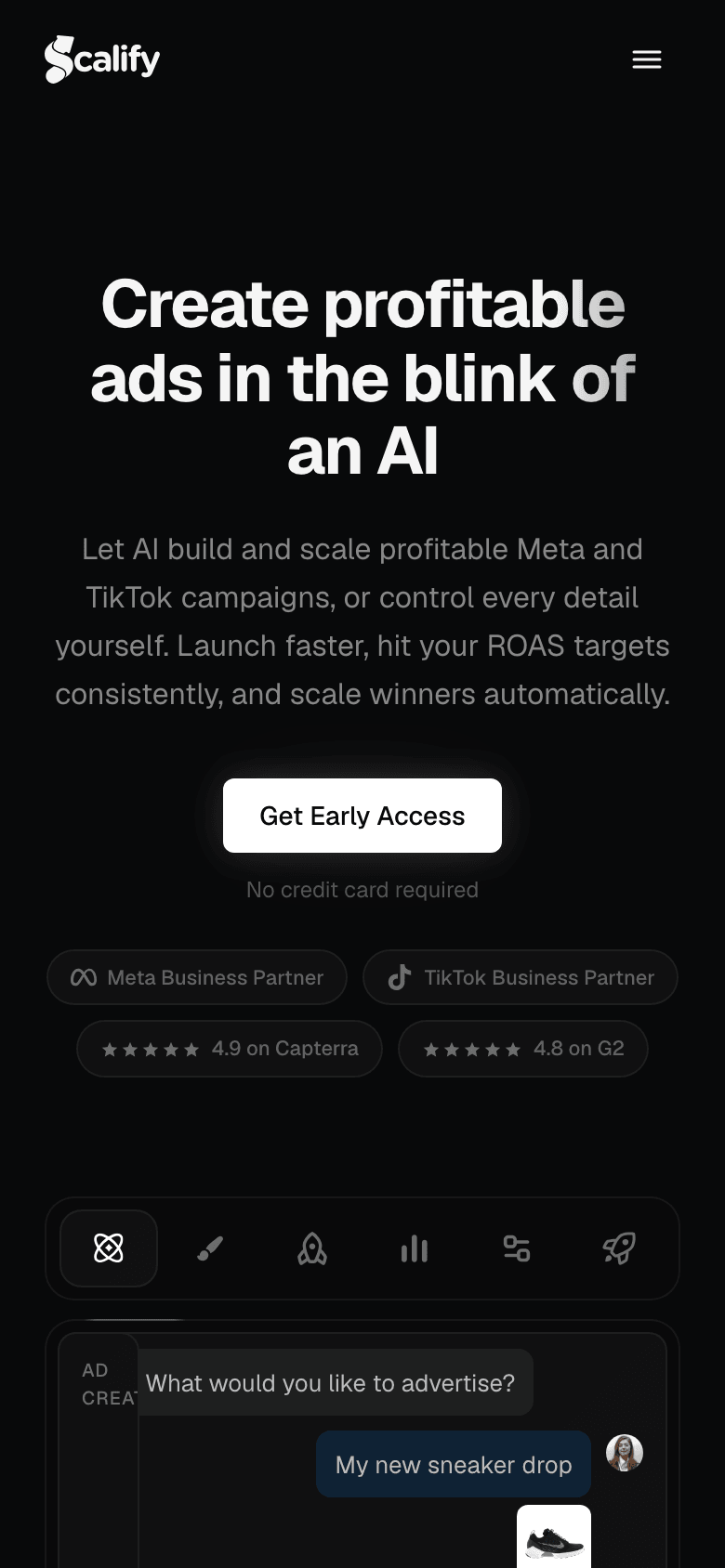
Scalify is an ads-automation platform that helps marketers run Facebook and Google campaigns without living inside ad managers. For v3 I led the front-end rebuild and the AI agent that became the product’s headline feature.
Problem
Scalify v2 worked, but it was slow and it still asked users to think like the ad platforms it wrapped. Time-to-interactive sat around four seconds, and every campaign still meant navigating forms, audiences and creative specs by hand. The team wanted v3 to feel instant and to let people simply describe what they wanted.
My role
I owned the front-end architecture and led the AI media-generation and agent work across a team. Concretely, that meant rebuilding the app on Vue 3 and Nuxt, designing the in-app agent, and shipping multilingual support, real-time creative previews and end-to-end test coverage.
Key decisions
I rebuilt the client on Vue 3 + Nuxt + Vite, replacing the legacy bundle and cutting time-to-interactive from roughly four seconds to under one across 23,000+ active users.
I designed the AI agent as a tool-based system on Anthropic Claude, not a scripted chatbot. The agent exposes discrete tools — create campaign, generate creative, fetch analytics, suggest next action — and Claude decides which to call from a natural-language request. The conversation is the interface; the real work happens through typed tool calls against our APIs.
For creatives, I integrated AI media generation — including video and image models such as Veo 3 and Nano Banana — behind real-time previews, so users saw results as the agent produced them. I also built the multilingual i18n layer so the whole experience, agent included, works across eight languages.
Outcomes
- 23,000+ users run campaigns through the v3 experience.
- Time-to-interactive dropped from ~4s to under 1s after the Vue 3 + Nuxt rebuild.
- The Claude agent turns a sentence like “launch a retargeting campaign for last month’s visitors” into a real, reviewable campaign.
- Cypress end-to-end tests cover the critical campaign-creation paths, so the agent’s actions stay trustworthy as the product changes.
Lessons
The biggest lesson was that agent reliability is a product of tool design, not prompt cleverness. Once each action was a small, well-validated tool, the model’s job shrank to choosing and sequencing — which it does well. The second lesson: real-time feedback makes AI feel trustworthy. Seeing a creative appear as it generates does more for confidence than any amount of copy promising quality.